By: Linda Dede Nyanya Godji Incoom
Two years after its commissioning, the Jamestown Fishing Harbour in Accra is providing fishers and fish traders with modern facilities to support their businesses. However, shallow waters that prevent trawlers from accessing the facility, a short breakwater, and the reluctance of some traders to use the designated modern fish market are limiting its full potential.
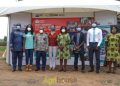
These issues emerged during a visit by journalists to the harbour on Wednesday, September 30, under the Save Our Seas campaign, a six-month nationwide initiative implemented by the Ghana Agricultural and Rural Development Journalists Association (GARDJA) in partnership with the Earth Journalism Network (EJN).
During the visit, journalists were taken around the harbour’s facilities, including the ice-making plant, cold storage facility, fish landing area and modern fish market. The tour provided an opportunity to assess the benefits of the infrastructure, hear from harbour management and fishing community members, and examine challenges affecting the facility’s operations and environmental sustainability.
In an interview, the General Manager of the Ghana Ports and Harbours Authority (GPHA) at the Jamestown Fishing Harbour, Ing. Stephen Owiah, identified shallow waters and the short breakwater as major challenges, explaining that the harbour could not currently accommodate trawlers because of the limited water depth.

“We can’t get the trawlers coming to use the facility also because the water we have is so shallow,” he said.
Ing. Owiah said management was considering dredging the harbour to deepen the water and enable larger fishing vessels to use the facility, with management assessing the necessary estimates and budget. He expected work on the ground to begin within the next two to three years. He also called for private-sector participation to support efforts to make fuller use of the harbour’s facilities.
Plastic waste accumulating along the harbour’s shoreline is another concern. Ing. Owiah explained that the existing breakwater was too short to, among other things, prevent plastic waste carried by the sea from reaching the harbour. He said management was considering extending it to help address the problem.
Despite these challenges, the harbour has facilities intended to improve fish preservation, handling and marketing. It has a 60-tonne-capacity ice plant and storage facilities with a capacity of 600 metric tonnes, producing ice over an eight-hour cycle, with individual blocks weighing approximately 45 to 47 kilogrammes.

The harbour also has a designated fish market intended to provide traders with an organised place to sell their catch. However, during the visit, several traders were still selling outside the market, close to where fishermen land their fish.
One fish seller, Odey Lokko, said concerns about water draining from fish inside the modern market and the condition of the market’s drainage system had discouraged many traders from moving into the facility. She expressed concern that stagnant water could produce unpleasant smells and affect trading conditions.
However, Ing. Owiah said the traders had refused to move into the new market because they were requesting a traditional opening ceremony. He explained that although a traditional ceremony was held during the official opening of the main harbour, management was willing to organise one for the market separately. He said this would allow GPHA to insist that traders begin using the modern market facility.
Ing. Owiah also disputed the suggestion that stagnant water was a major problem inside the market, explaining that systems had been provided to channel wastewater to a treatment plant.
A few traders were seen using the facility. One of them, Naa Amankwah, described the market as a good facility, acknowledged GPHA’s efforts to keep it clean and expressed hope that more traders would move inside.
The differing views highlight the need for continued engagement between harbour management and fish traders to address concerns about drainage, sanitation and trading conditions.
Speaking about the campaign, GARDJA Project Coordinator, Nana Yaw Kesseh, explained that the six-month Save Our Seas campaign brings journalists into coastal communities, including areas in the Greater Accra and Central regions, to engage directly with artisanal fishers, fishmongers and industry management.
According to Kesseh, the initiative seeks to strengthen advocacy and hold stakeholders in the fishing industry accountable. It also highlights how declining fish stocks threaten local food security and coastal livelihoods, while generating evidence that can inform policymakers.
He said the campaign supports Ghana’s efforts to achieve the global 30×30 conservation target by 2030 under the Kunming-Montreal Global Biodiversity Framework, which calls for the conservation of 30 per cent of the world’s land and ocean areas by the end of the decade.
Kesseh expressed appreciation to EJN for its funding support, describing it as a critical investment in journalism-driven environmental protection and sustainable development.
In support of efforts to address the infrastructure and marine environmental issues, the Chief Fisherman, Nii Abeo Kyerekuanda V,said the fishing community was ready to support GPHA in its plans to maintain the standard of the harbour.
His assurance points to the role fishing communities can play in protecting facilities that support their livelihoods and promoting the responsible use of coastal resources.
-END-