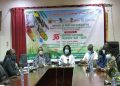
Panama City, September 18, 2026 (IICA) – A new academic institution that aims to train young talent for the transformation of agriculture in Panama was inaugurated by the country’s president, José Raúl Mulino, in an event attended by the Director General of the Inter-American Institute for Cooperation on Agriculture (IICA), Muhammad Ibrahim.
This is the Center for Agricultural Specialties (CEAGRO AIP), intended for specialized higher technical training in the productive sector.
The presentation ceremony was attended by 100 scholarship recipients who make up the institution’s first generation of students, coming from different parts of the country.
The launch of the center demonstrates Panama’s commitment to training young people for the future of food, fiber, and energy production. The goal is to provide educational and professional development opportunities to encourage young people to remain in rural areas through more modern agriculture that incorporates new technologies and meets evolving consumer demands.
During the event, Panamanian national authorities highlighted IICA’s contribution to the creation of CEAGRO AIP, a process in which the organization contributed its experience in agricultural education, capacity building, innovation, and new technological frontiers applied to agriculture.
“It fills me with satisfaction to welcome its first 100 young people, from all the provinces and regions of Panama, who arrive with a dream and the opportunity to build their future in agriculture,” Mulino stated.
The Panamanian president emphasized that the creation of CEAGRO AIP is open to young people who want an opportunity to build a life in agriculture through hard work. He affirmed that the new institution aims to address the real needs of the labor market and create opportunities for young people to enter the workforce.
Of the first 100 students – it was reported – 70% come from agricultural high schools and 30% from science high schools, with equal participation between men and women.
Ibrahim, accompanied by the IICA Representative in the country, Miguel Ángel Arvelo, considered that the Panamanian CEAGRO AIP can become a benchmark experience for other countries in the Americas and highlighted Panama’s ability to quickly and efficiently transform an innovative idea into a concrete and operational initiative.
“This experience will help demonstrate that it is possible to build new models of agricultural education that integrate technical knowledge, innovation, digital tools, new technologies, entrepreneurship and a direct relationship with the productive needs of the territories,” said the Director General of IICA.
CEAGRO AIP will develop an educational model based on the principle of “learning by doing”, with training consisting of 40% theoretical content and 60% practical experiences, to promote early contact of students with production processes, technology, innovation and the resolution of real problems.
The training will last two years and will be geared towards strategic areas related to agricultural production, agro-industry, the management of agricultural businesses, technologies applied to agriculture, mechanization and aquaculture.
The Director General of IICA, Muhammad Ibrahim, considered that CEAGRO AIP can become a benchmark experience for other countries in the Americas.
Linking scientific capabilities
During his visit to Panama, Ibrahim met with the Minister of Agricultural Development, Roberto Linares, and they identified opportunities to strengthen their collaboration. Linares is the president of the IICA Executive Committee, one of its main governing bodies, a position to which he was elected this year by a vote of the Ministers of Agriculture of the Americas.
The Director General of IICA also visited the Regional Center for Innovation in Vaccines and Biopharmaceuticals (CRIVB AIP), a Panamanian initiative with a clear regional focus. In discussions with the Center’s director, Paulina Franceschi, and her team, they explored opportunities for collaboration and joint work that would leverage IICA’s capabilities, its presence in the countries, and its international cooperation network to contribute to the Center’s development and expand its reach throughout Central America and the Caribbean.
One of the central themes was the possibility of IICA contributing to building alliances with scientific institutions, international organizations, universities and research centers, as well as identifying opportunities for researchers and specialists from countries in the region to participate in initiatives related to innovation in vaccines, biopharmaceuticals and biotechnology.
The visit also opens up a particularly interesting space to link high-level scientific capabilities with some of the major challenges shared by agriculture, health, and rural territories.
For IICA, the new technological frontier makes collaboration between disciplines, institutions, and countries increasingly necessary, in order to put science and innovation at the service of concrete solutions. In this sense, the CRIVB represents an opportunity to project a scientific cooperation platform with regional impact from Panama.
The agenda of the Director General of IICA in Panama also included a meeting with the Indonesian ambassador to the country, Hendra Halim, with whom he discussed possible cooperation actions on
The Director General of IICA held a meeting with the Indonesian ambassador to Panama, Hendra Halim, where they discussed opportunities for cooperation on agricultural issues and natural disaster management.
About IICA
It is the international organization specializing in agriculture of the Inter-American System, whose mission is to stimulate, promote and support the efforts of its 34 Member States to achieve agricultural development and rural well-being through international technical cooperation of excellence.
More information:
Institutional Communication Management
institutional.communication@iica.int
_END_