From FAO Regional Office for Africa
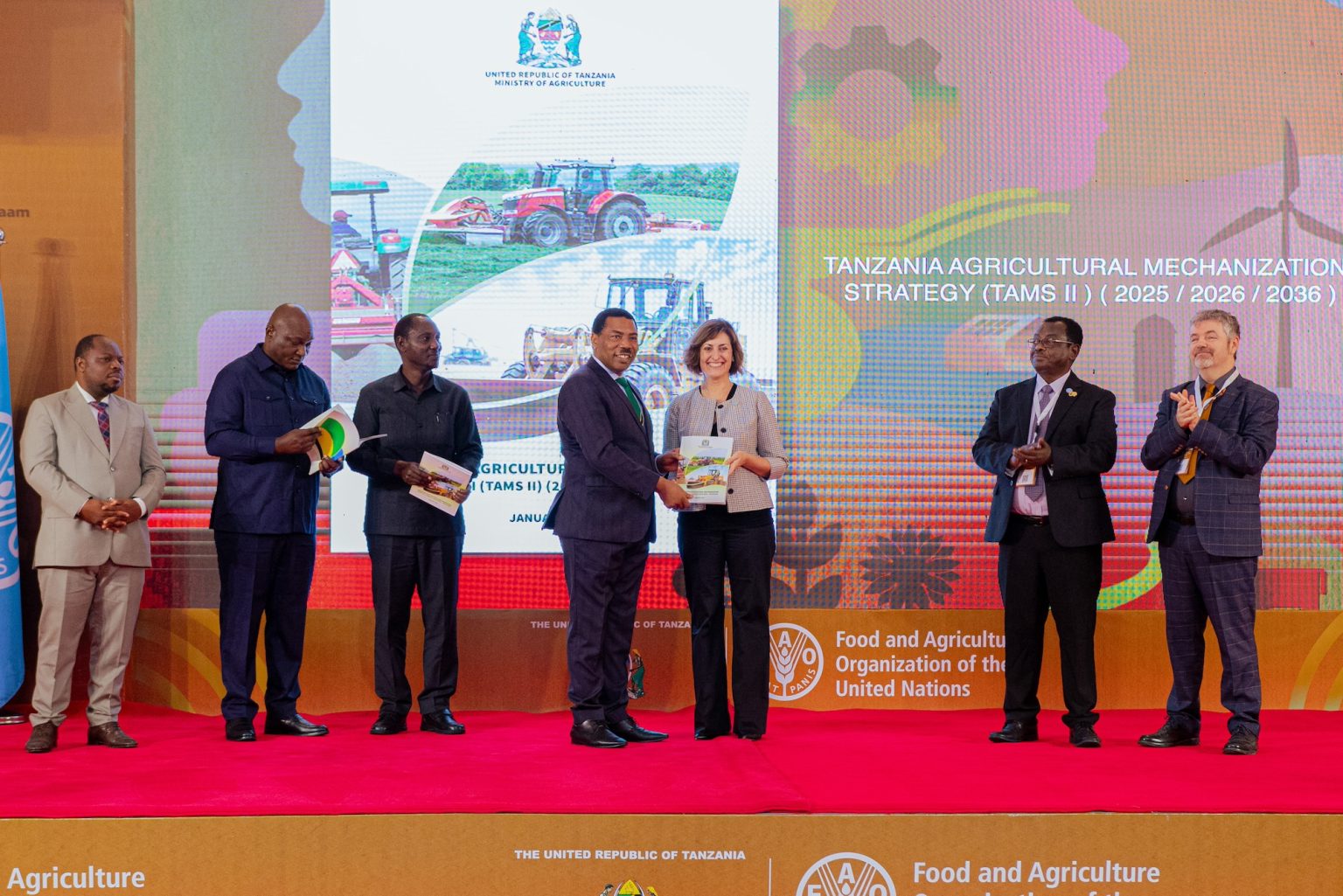
Africa’s push to accelerate sustainable agricultural mechanization gained fresh momentum today as the Prime Minister of the United Republic of Tanzania, Mwigulu L. Nchemba, launched Tanzania’s National Agricultural Mechanization Strategy 2026–2036 at the opening of the Africa Conference on Sustainable Agricultural Mechanization.
Organized by the Food and Agriculture Organization of the United Nations (FAO) and hosted by the Government of the United Republic of Tanzania, the conference brings together governments, the private sector, researchers, development partners, youth and farmers to exchange experience, build partnerships and identify scalable solutions to advance sustainable agricultural mechanization across the continent.
Opening the conference, Prime Minister Nchemba underscored mechanization as a strategic necessity: “Through action, we can change Africa’s agriculture to be a mechanized sector that is sustainable, for this generation and future generations.”
He said the new 10-year plan is aligned with the FAO-African Union Framework for Sustainable Agricultural Mechanization in Africa (F-SAMA) and ensures women and youth are at the heart of change. The conference marks the first regional convening since the global conference and exhibition held in Rome in 2023, and represents a decisive shift toward Africa-led action.
It builds on growing momentum to translate global commitments into practical solutions—solutions designed in Africa, for Africa—supporting farmers today while creating meaningful opportunities for the young people who will drive the continent’s agricultural transformation.
“Mechanization today cannot look like mechanization of the past. Shipping in large machines without financing, training, repair services, or local adaptation has not delivered lasting results. Africa does not need more equipment sitting idle. It needs systems that work,” said FAO Deputy Director-General Beth Bechdol.
“At FAO we see sustainable mechanization as a catalyst for transformation – not as machines replacing people, but tools empowering people, reducing back-breaking labour and creating space for women to farm more productively,” added Ms Bechdol.
Achieving this shift, she said, requires evidence-based solutions, strong local manufacturing and service ecosystems, innovative financing models, enabling policies, and—above all—partnerships.
“The importance of sustainable agricultural mechanization cannot be over-emphasized,” said Moses Vilakati, African Union Commissioner for Agriculture, Rural Development, Blue Economy, and Sustainable Environment. “Our mechanization agenda is also a dignity agenda” he stressed.
Africa’s mechanization gap – why it matters
Africa continues to lag behind other regions in farm power. While much of Asia and the Near East rapidly expanded tractor use, many farmers remain dependent on manual or animal labour. Past mechanization efforts often faltered because equipment was poorly suited to smallholder systems and unsupported by local supply chains for maintenance, spare parts and repair.
Yet, Africa holds around half of the world’s uncultivated arable land – about 202 million hectares, indicating enormous potential. At the same time, Africa’s crop yields are only 56 percent of the global average, and despite about 60 percent of Africa’s population depending on agriculture for jobs and livelihoods, the sector contributes only around 21 percent of GDP.
Sustainable mechanization is central to closing these gaps. When embedded in local ecosystems, mechanization creates skilled jobs, reduces the drudgery, improves efficiency, cuts losses and enables climate-smart practices.
“Choosing a new direction that embraces mechanization, digitalization, scientific innovation and inclusive policies can fundamentally transform Africa’s agrifood landscape,” said FAO Assistant Director-General and Regional Representative for Africa Abebe Haile-Gabriel.
During the opening morning, Chef and FAO Regional Goodwill Ambassador for Africa Fatmata Binta told delegates of a joint project with FAO that introduced processing machines for the local grain fonio. “When we invested in fonio processing machines, what was once a burden became an opportunity. Mechanization gave the women back their time, their energy and their motivation,” she said.
Across the continent, a new generation of mechanization is emerging —combining compact, context-appropriate machinery, digital platforms for machinery hire, drones, and new service jobs such as machine operators, drone pilots, technicians and data analysts.
Over the coming days, FAO will reiterate its support to Members on adopting sustainable mechanization solutions. The conference will spotlight youth job opportunities, digital transformation, and ways to boost investment and financing. Participants will also visit a youth incubation centre and a rice mechanization cooperative.
The conference runs until 6 February.
Source: Access Agric